
This is an old revision of the document!
Table of Contents
The Knowledge Asset Review Workflow
Purpose
The Knowledge Asset Review Workflow is a structured process within OHKMS designed to ensure that knowledge assets submitted to the platform are accurate, relevant, complete, appropriately classified, and suitable for dissemination to their intended audiences.
The workflow provides a systematic mechanism for evaluating knowledge assets before they are published and made accessible to OHKMS users. It supports quality assurance, accountability, consistency, and the integrity of information shared through the system.
Through this workflow, authorized reviewers can examine submitted knowledge assets, provide feedback, request revisions, approve submissions, or reject assets that do not meet the established quality requirements.
Overview
Knowledge assets may include technical reports, research publications, policy briefs, guidelines, training materials, case studies, standard operating procedures, presentations, and other resources relevant to the One Health approach.
The review workflow is initiated when a knowledge asset is submitted for review. Depending on the configured approval process, the asset is assigned or made available to an authorized reviewer who evaluates its content and supporting information.
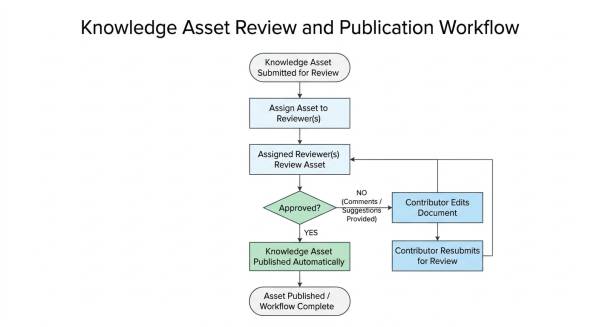
The review process generally involves the following stages:
- Submission: A contributor submits a knowledge asset for review.
- Review Assignment: The system routes the submitted asset to an authorized reviewer.
- Evaluation: The reviewer examines the asset and its associated metadata.
- Review Decision: The reviewer approves the asset, requests revisions, or rejects the submission.
- Revision and Resubmission: Where revisions are requested, the contributor updates the asset and submits it again.
- Approval and Publication: Approved assets proceed to publication according to the configured publishing permissions.
Knowledge Asset Review Workflow Diagram
The following diagram illustrates the logical sequence of activities and decisions involved in the review process.
Knowledge Asset Review Statuses
The review workflow uses status indicators to communicate the current stage of a knowledge asset. The following table describes common workflow statuses; actual status names may differ in OHKMS.
| Status | Description |
|---|---|
| Draft | The asset has been created but has not yet been submitted for review. |
| Pending Review | The asset has been submitted and is awaiting evaluation. |
| Under Review | An authorized reviewer is evaluating the asset. |
| Revision Requested | The reviewer has requested corrections or additional information. |
| Resubmitted | The contributor has revised the asset and returned it for evaluation. |
| Approved | The asset has successfully completed the required review process. |
| Rejected | The asset has not met the requirements for approval. |
| Published | The approved asset has been made accessible to its intended audience. |
Roles and Responsibilities
The knowledge asset review process involves different user roles, each with specific responsibilities.
| User role | Primary responsibilities |
|---|---|
| Knowledge Contributor | Creates, submits, revises, and resubmits knowledge assets. |
| Knowledge Reviewer | Evaluates submitted assets, provides feedback, and records review decisions. |
| Knowledge Manager or Publisher | Oversees content quality and publication, where this role is configured. |
| System Administrator | Manages user permissions, workflow configurations, and technical issues affecting the review process. |
Note: The availability of these roles and their specific permissions depends on the OHKMS role-based access-control configuration.
Best Practices
To maintain the quality and effectiveness of the Knowledge Asset Review Workflow, reviewers and contributors should observe the following practices:
- Maintain objectivity: Evaluate assets against established quality criteria rather than personal preferences.
- Provide constructive feedback: Clearly identify deficiencies and explain the required corrections.
- Ensure metadata accuracy: Verify that titles, descriptions, keywords, and classifications correctly represent the knowledge asset.
- Protect sensitive information: Confirm that restricted or confidential information is handled according to applicable policies.
- Avoid unnecessary delays: Review assigned assets promptly and communicate revision requirements clearly.
- Maintain traceability: Record review comments and decisions to support accountability and future reference.
- Verify final publication: Ensure that approved knowledge assets are correctly published and accessible to their intended audiences.